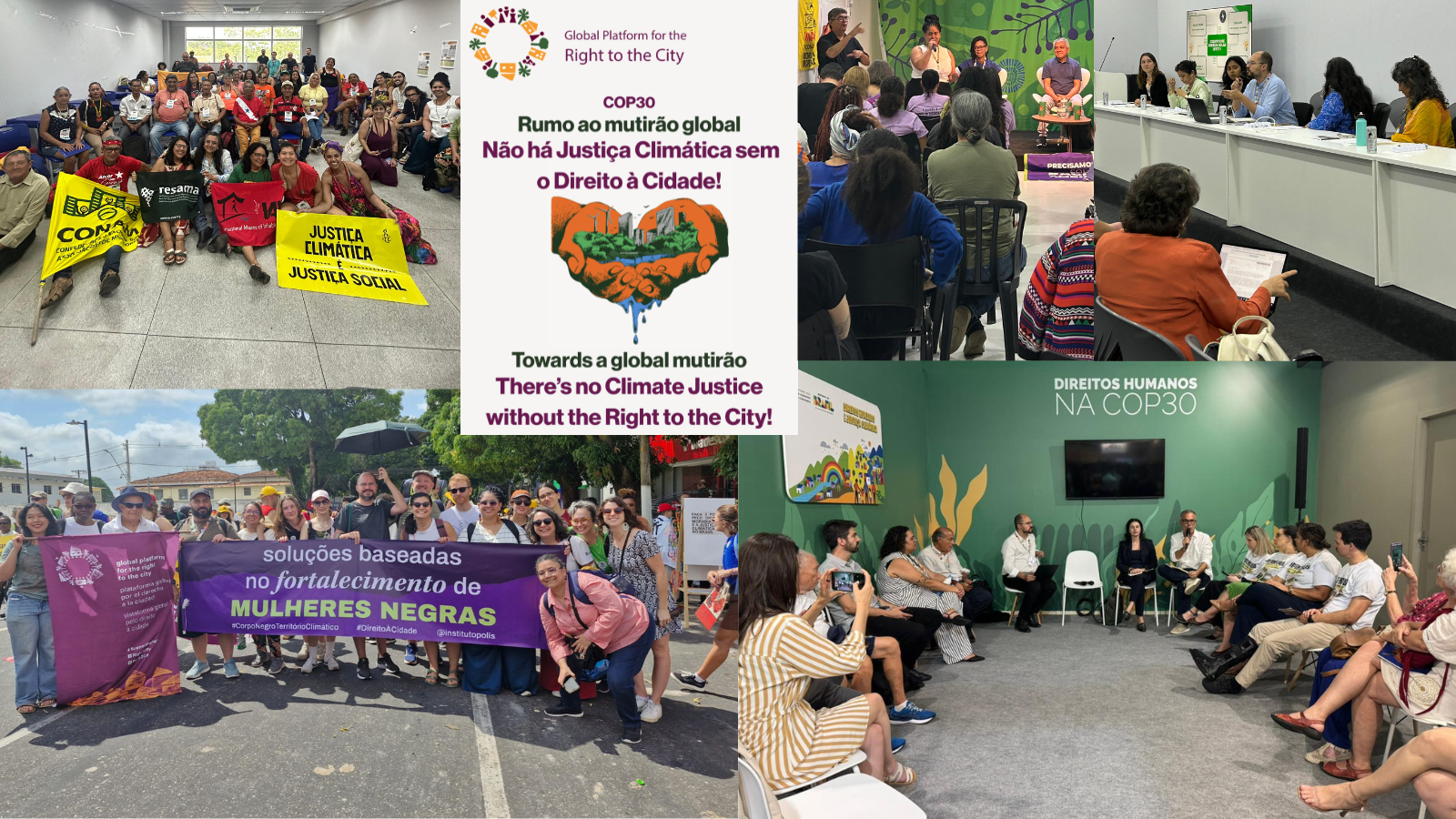

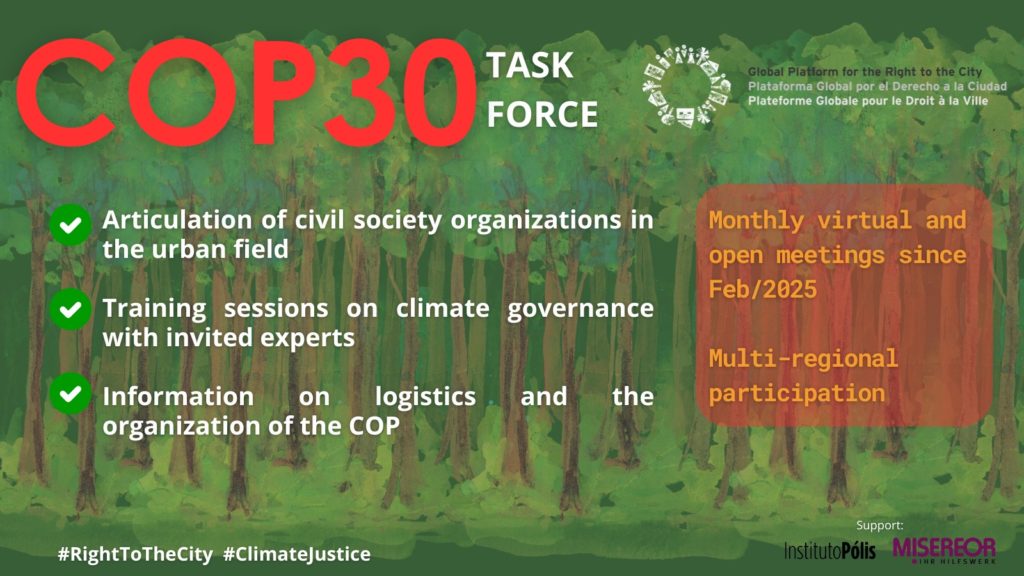
For some years now, we have been working on the connections between climate justice and the right to the city. Starting with the publication of our thematic paper in 2020 and continuing to work with our members on local, national, regional and global initiatives. This work intensified towards COP30, with great expectations from social and territorial movements about the process. In this context, during 2025, we held 9 meetings in the framework of a task force to prepare our joint participation. This effort included capacity-building, as well as the joint creation of a common agenda and strategies towards the conference to strengthen the presence and participation of urban social movements and civil society organizations in the debate on climate justice.
You can find out more about the platform’s campaign at COP30 here. Below, check out all the meetings of the platform’s task force for the climate conference in Belém.
1st meeting – February
Initial meeting
The meeting was a kick-off to align our collective efforts, exchange ideas and create strategies on how to maximize our impact, both at the COP and beyond, ensuring that the right to the city perspective on climate justice is considered and that our voices are effectively represented.
The meeting served both as an information session and as a first moment of coordination, focusing not only on participation at the COP, but also on how best to coordinate and strengthen our capacities in relation to climate justice.
2nd meeting – March
Information session on COPs
The focus of this meeting was to share basic information about the COPs, especially how they work and how to participate. The main points covered were: important dates; opportunities and modalities for participation; logistics and joint agenda.
3rd meeting – April
Towards a joint strategy
The session was dedicated to finding key points from our common work on the intersection between climate justice and the right to the city, in order to inform a joint strategy. To support the development of the session, we mapped out some of the central points of our approach, based on previous and ongoing work.
Some of the main points identified as climate justice strategies were: climate finance for cities; strategic litigation; co-production of policies and data; capacity building; and comprehensive neighborhood improvement.
Among the priorities for COP30, the following topics were listed: impacts of climate change on territories; adaptation strategies; local climate plans and participatory methodologies; water, housing and land rights.
4th meeting – May
Expectations and preparations for COP30
The meeting discussed recent progress in the run-up to the conference and the expectations of different organizations.
In the institutional update, Mila Dezan, from the General Secretariat of the Brazilian Presidency, highlighted initiatives to broaden social participation, strengthen the Green Zone, create an inventory of civil society solutions and organize a national pre-COP in October. Rayne Moraes, UN Habitat Brazil Country Officer, and Rodrigo Führ, UN-Habitat Focal Point for COP30, presented their agenda for COP30, including days dedicated to urban issues, a ministerial meeting on Urbanization and Climate Change, the Local Leaders Summit and the Cities and Regions Hub. The meeting also included updates on the pre-COP negotiations in Bonn, where the main discussions would focus on defining 100 global adaptation indicators.
5th meeting – July
Climate negotiations in Bonn
The meeting presented an overview of the climate negotiations held in Bonn, highlighting the central role of the UNFCCC Subsidiary Bodies in the run-up to the COP in Belém. Reports emphasized procedural challenges, tensions over financing and limited progress on issues such as adaptation and just transition.
Key points included the synthesis of the 490 adaptation indicators into a final list of 100, the impasse around the New Collective Financing Target (NCQG) and the growing pressures on infrastructure and logistics for COP 30. Also noteworthy was the renewal of the Lima Work Program on Gender and the start of negotiations on a new action plan with an intersectional focus.
The panel on climate finance delved into the structural challenges of the issue, pointing out the insufficiency of resources, the excessive debt burden, the difficulty of access by vulnerable communities and the limits of the Loss and Damage Fund. The meeting was attended by Michelle Ferreti (Instituto Alziras), Adriana Vásquez Rodríguez (La Ruta del Clima), Julie Greenwalt, (Cities Alliance) and Lucas Turmena (UN University).
- Watch the video recording
- Access the summary document
- Download the presentations:
6th meeting – July
Climate adaptation
Training session on climate adaptation, its imbalance in relation to mitigation, and the global adaptation goal (GGA), including indicators related to human settlements. We also brought some examples of how adaptation occurs in the urban context and shared information about the People’s Summit and the possibilities for coordination and advocacy at the event.
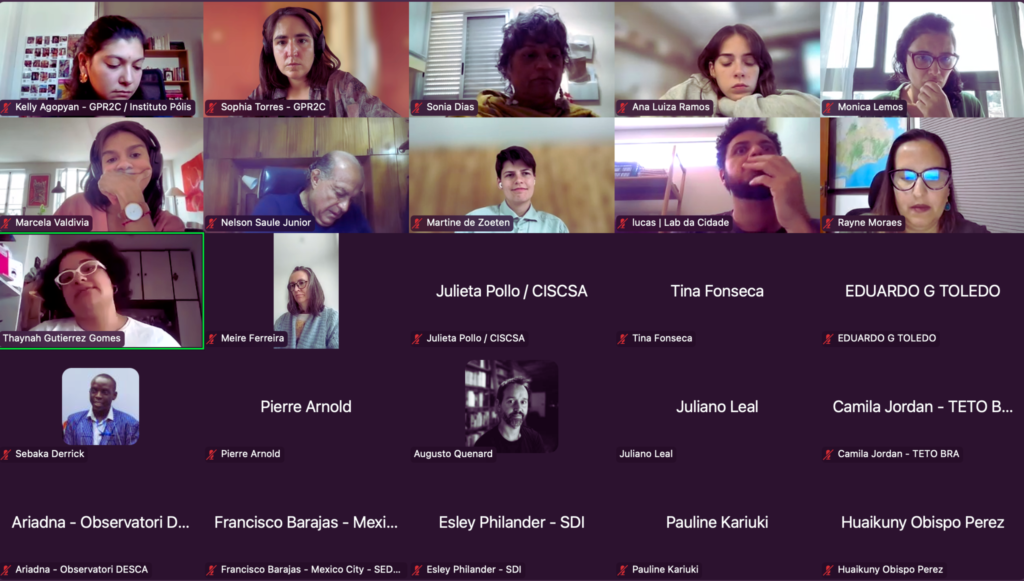
The meeting was attended by Thaynah Gutierrez (Climate Observatory), Martine De Zoeten and Rayne Moraes (UN-Habitat), Pauline Kariuki (Huairou Commission), Sonia Dias and Marcela Valdivia (WIEGO) and Julia Ladeira (MTST).
- Watch the video recording
- Download the presentations:
7th meeting – August
Nationally Determined Contributions (NDCs)
Special session in partnership with the International Habitat Coalition of Latin America (HIC-AL) and Misereor, to address the Nationally Determined Contributions (NDCs) and how cities can contribute to and influence these climate goals.
Check out the final document here, the result of these joint meetings facilitated in partnership with HIC-Latin America, Misereor, IIED-AL and Foro Ciudades para la Vida.
8th meeting
September 30, 2025
Presentation of the position paper we drew up on the basis of the sessions held in the task force, including the GPR2C’s key messages for COP30.
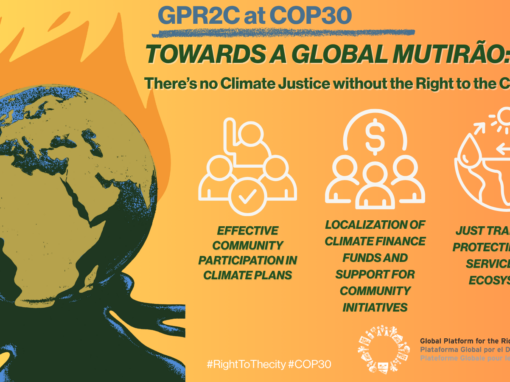
These include: the participation of communities in mitigation plans and the implementation of NDC 3.0; building the territorial components of the Global Goal on Adaptation; decentralizing and leveraging local climate finance; and safeguarding the social and environmental function of basic services and ecosystems.
We also shared some of the activities proposed for COP30, both in the official spaces of the conference and in the parallel spaces.
9th meeting – October
Position paper
At the last meeting before COP30, we went over logistical details, our final common position paper and the agenda of activities confirmed so far.