
GPR2C joins a movement‑rooted gathering on the Social and Solidarity Economy during UNGA Week and Climate Week NYC
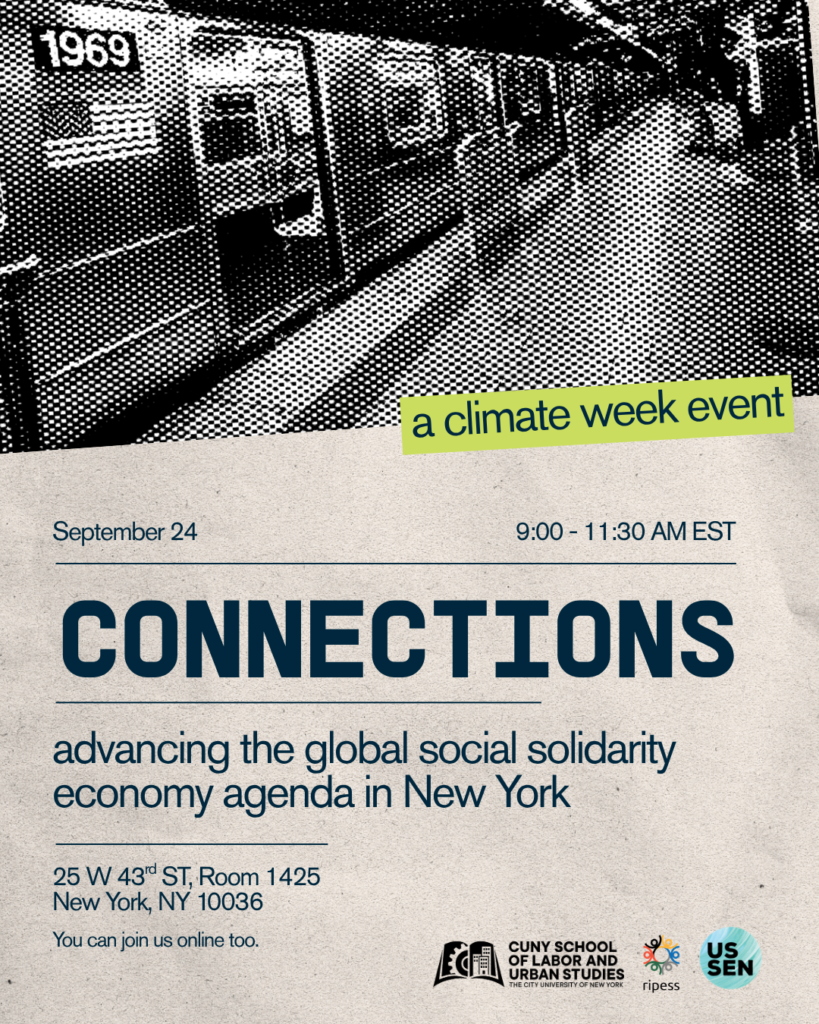
24 September 2026 · 09:00–11:30 CUNY School of Labor and Urban Studies, New York City
The Global Platform for the Right to the City (GPR2C) will particpate in Connections: advancing the global social solidarity economy agenda in New York, a movement‑rooted gathering taking place on 24 September 2026 during the UN General Assembly and Climate Week NYC.
RIPESS Intercontinental — a long‑standing member of GPR2C — will co‑organize the event together with the CUNY School of Labor and Urban Studies and the U.S. Solidarity Economy Network (USSEN).
As part of its commitment to advancing democratic, just and sustainable cities, GPR2C will join community organizations, cooperatives, international networks and allied movements to strengthen the political agenda of the Social and Solidarity Economy (SSE) as a pathway toward climate justice, economic democracy and collective self‑determination.
A Right‑to‑the‑City Approach to Climate Justice and Economic Transformation
The climate crisis cannot be addressed through technological solutions or financial commitments alone. It is inseparable from deepening inequality, extractivism, precarious work, dispossession, and unequal access to land, housing, food and care.
From a Right to the City perspective, advancing climate justice requires transforming economic systems so that power and resources are redistributed, common goods are protected, and communities can collectively shape their territories and futures.
The Social and Solidarity Economy contributes to this transformation when it expands community control over housing, land, food, work, care, finance, waste and digital infrastructures. This gathering will explore how public policy, international cooperation and multilateral processes can support — rather than instrumentalize or depoliticize — the collective practices that make the SSE possible.
Dialogue Between Movements and Institutions
The session will feature a dialogue between movement actors and institutional representatives, including the Government of Spain, UN DESA, USSEN, WIEGO, URGENCI, and GPR2C.
This exchange aims to strengthen the role of grassroots and community‑based organizations in shaping the implementation of UN General Assembly Resolutions 77/281 and 79/213 on the Social and Solidarity Economy.
Objectives of the Gathering
- Present and discuss a political analysis of the 2026 UN Secretary‑General’s Report on the SSE, including key findings, gaps and recommendations.
- Identify movement priorities and risks for future UN resolutions on the SSE.
- Highlight concrete practices and political demands of SSE movements as essential evidence for implementing Resolutions 77/281 and 79/213.
- Create a space for mutual learning among international networks, New York/U.S. organizations and allied movements.
- Strengthen relationships with grassroots, abolitionist, anti‑authoritarian and transformative movements.
- Develop a shared movement framework outlining the conditions required for the SSE to advance social justice, climate justice, democracy, ecological sustainability and collective self‑determination.
- Identify practical next steps for continued collaboration among GPR2C, RIPESS, the CUNY School of Labor and Urban Studies, USSEN and participating organizations.
Agenda Highlights
09:00–09:10 Welcome and political opening CUNY School of Labor and Urban Studies and local hosts
09:10–09:40 The UN moment: recognition, gaps and movement questions Government of Spain · RIPESS · UN DESA
09:40–10:20 Movement dialogue: Building economic democracy from the ground up USSEN · WIEGO · URGENCI · GPR2C
10:20–10:40 Research and academic insights: building alliances Community Worker Ownership Project · Human Rights Agenda
10:40–11:10 Breakout / plenary: What must a movement‑rooted SSE agenda deliver? Collective identification of priorities for implementing Resolution 79/213
11:15–11:30 Closing reflections and next steps
Participants and Contributors
- Rebecca Lurie, Community Worker Ownership Project (CWOP), CUNY School of Labor and Urban Studies
- Jaime Iglesias, Commissioner for the Social Economy, Government of Spain
- Sandra Moreno Cadena, Executive Secretary, RIPESS Intercontinental
- Andrew Allimadi, Social Affairs Officer, UN DESA
- Sonia Dias, WIEGO
- Melanie Bush, USSEN
- Kate Anstreicher, Glynwood Center for Food and Farming – URGENCI
- Rob Robinson, Global Platform for the Right to the City (GPR2C)
- Marc Edelman, Hunter College & CUNY Graduate Center