
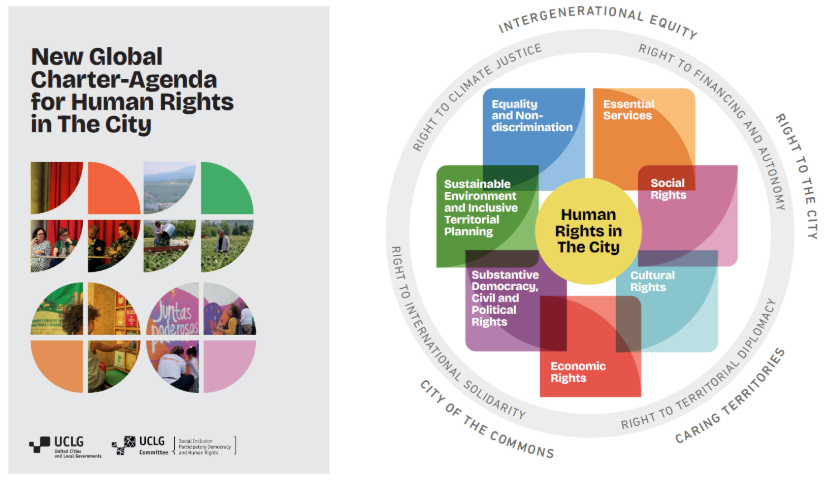
The global network of local and regional governments, United Cities and Local Governments (UCLG), adopted the New Global Charter-Agenda for Human Rights in the City on 25 June 2026 during its World Congress in Tangier. The Charter is a political commitment and practical framework that places human rights at the heart of local governance.
The Global Platform for the Right to the City (GPR2C) played an active role throughout the drafting and revision process of this instrument, participating in the international steering committee alongside local governments, experts, and partner organizations. Contributing organizations included the Global Platform for the Right to the City, the Raoul Wallenberg Institute of Human Rights and Humanitarian Law, and the European Union Agency for Fundamental Rights, together with representatives of cities and territories from different regions of the world.
The new Charter-Agenda is grounded in the understanding that human rights are realized in territories, where people live, work, participate, and access essential services. The document promotes a human rights-based approach to local and regional public policies, strengthening the role of cities as key actors in advancing democracy, equality, and social justice.
“The Charter reflects the progress achieved by local and regional governments, the expansion of the human rights agenda, and the maturation of the Right to the City movement, and seeks to inspire the next decade of the Human Rights Cities movement and the recognition of a new generation of rights.”
The updating process was driven by a broad participatory initiative launched in 2022 by UCLG and its Committee on Social Inclusion, Participatory Democracy and Human Rights (CISDPDH), involving local and regional governments, civil society organizations, academia, international institutions, and networks committed to human rights and the Right to the City.
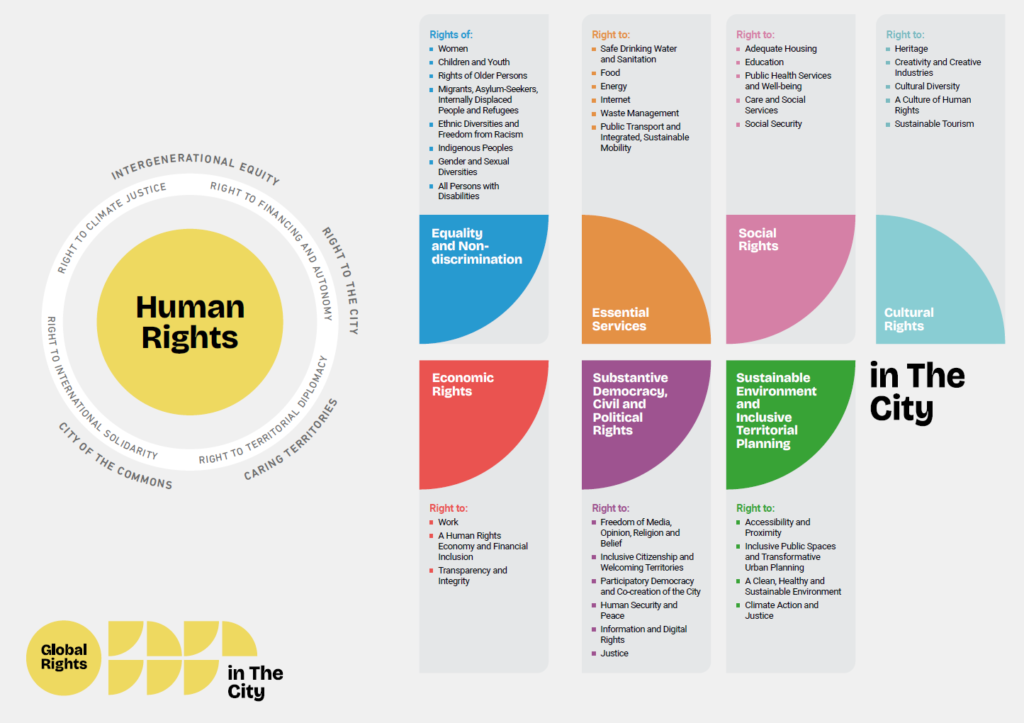
The Charter recognizes 37 human rights, organized into seven thematic clusters, covering areas ranging from essential services and social rights to participatory democracy, climate justice, and cultural, economic, and environmental rights. It also includes an eighth cluster dedicated to the Rights of Cities, advocating for the political, financial, and institutional conditions necessary for local governments to effectively fulfil their human rights responsibilities.
One of the most significant aspects for the Global Platform for the Right to the City is that the Charter consolidates the Right to the City as the structural framework for a new generation of rights, integrating concepts such as Caring Territories, the City of the Commons, Feminist Municipalism, and Intergenerational Equity. These approaches contribute to building fairer, more inclusive, democratic, and sustainable territories.
The adoption of this new Charter-Agenda represents a milestone for the global Human Rights Cities movement and provides a key reference tool for local governments, social movements, and organizations committed to building people-centred cities, advancing spatial justice, and guaranteeing human rights for all.
Download the publication:
English: https://www.uclg-cisdp.org/sites/default/files/documents/files/2026-06/new_global_charter_agenda_for_human-rights_in_the-city-1.pdf
French: https://www.uclg-cisdp.org/sites/default/files/documents/files/2026-06/droits-humains_broxure_fr.pdf
Spanish: https://www.uclg-cisdp.org/sites/default/files/documents/files/2026-06/derechos-humanos_broxure_spa-1.pdf