
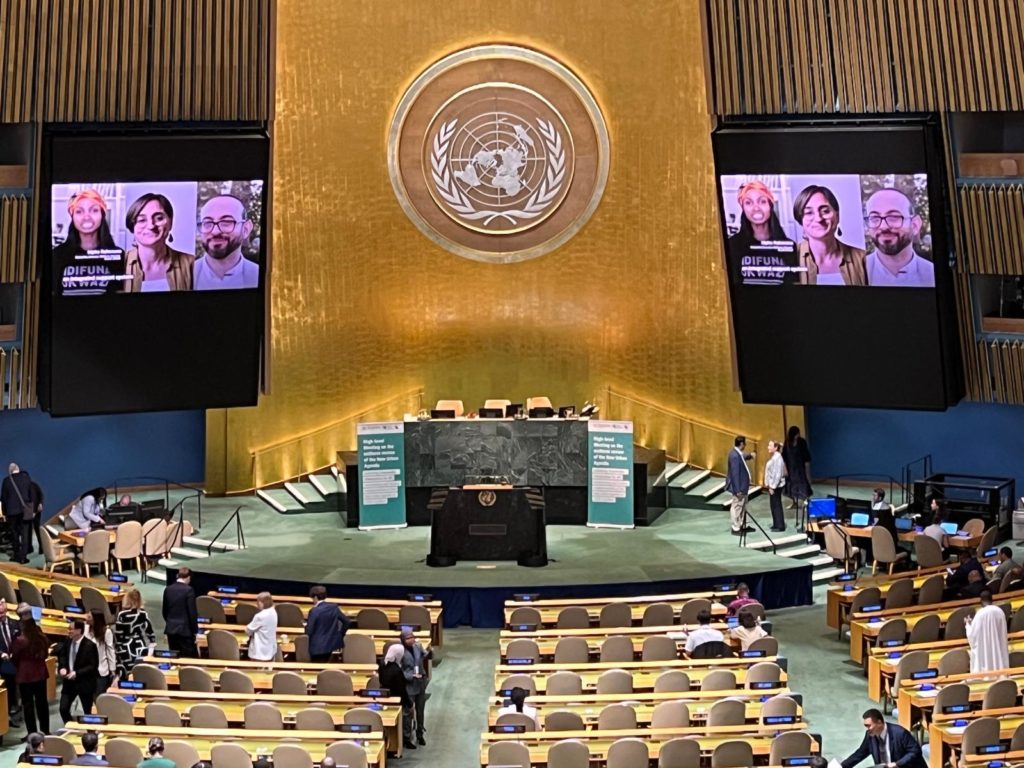
The Global Platform for the Right to the City (GPR2C) took part in the United Nations High-Level Meeting on the mid-term review of the New Urban Agenda, held on 16 and 17 July, contributing the perspective of the right to the city to the global debate on the future of sustainable urbanisation.
Ten years after the adoption of the New Urban Agenda (NUA) at Habitat III in Quito, the meeting provided an opportunity to assess the progress made since 2016, identify the main remaining challenges and set priorities to accelerate its implementation through to 2036.
Under the theme ‘Achieving sustainable urbanisation for all: jointly accelerating and scaling up the implementation of the New Urban Agenda until 2036’, the meeting brought together Member States, local and regional governments, United Nations agencies, civil society organisations and other stakeholders to discuss key issues such as housing, access to land, climate resilience, urban financing and multi-level governance.
The GPR2C participated in this process through its co-coordinator, Nelson Saule, helping to bring the demands and proposals of organisations, social movements and communities committed to fairer, more democratic and inclusive cities and territories into the international debate.
A Declaration that reaffirms commitments and leaves challenges unresolved
The meeting concluded with the adoption of a Political Declaration on the mid-term review of the New Urban Agenda, which reaffirms Member States’ commitment to its implementation until 2036.
The Declaration incorporates elements relevant to the right to the city, including:
- A people-centred and human rights-based approach to urban development.
- The recognition of local governments, community organisations, civil society and academia as key actors in implementation.
- Equitable access to infrastructure and services.
- The recognition of the social and solidarity economy, unpaid care work and workers in the informal economy.
- Gender equality, climate action and the strengthening of links between urban and rural areas.
These advances reinforce fundamental principles such as participation, social justice, equality and human rights.
The absence of the right to the city and of measures to tackle the financialisation of housing
Despite these advances, the right to the city is not explicitly mentioned in the final text, a significant omission given its growing relevance as a framework for addressing urban inequalities.
Furthermore, the Declaration does not adequately address one of the most pressing challenges facing millions of people: the financialisation of housing. Nor does it include sufficiently robust commitments to regulate property markets, curb speculation or prevent displacement.
For the GR2C, moving towards fairer cities requires ambitious public policies on housing, land and urban development that prioritise human rights over market interests.
GPR2C Statement for the HLP (High-Level Panel) on the NUA (New Urban Agenda): GPR2C may participate in the space opened for civil society through this statement:The relevance of having greater engagement and efforts with the vision of the Right to the City – City for All adopted in the NUA for its implementation.
Highlighting the relevance of the Right to the City as a collective human right of present and future inhabitants of just, inclusive, safe, and sustainable cities and human settlements as a key issue for the implementation of the NUA.
The relevance of systems and models of democratic and participatory governance and management in cities and human settlements as a strategic way to combat marginalization, segregation, inequality, and social, economic, and environmental vulnerabilities.
There is an urgent need for a global, national, and local financing system for programs and actions aimed at implementing the NUA.
For the implementation of the New Urban Agenda for the next ten years, we consider the following key points:
- Protection, promotion and implementation of the Right to the City and Climate Justice;
- Establishing new paradigms for planning such as participatory community management and public-community partnerships;
- Fulfilling the social climate function of the city and property, strengthening collective social, cultural and environmental interests;
- Incorporating the priorities, needs and experiences of citizens and communities, especially women, people in vulnerable situations, minorities and marginalized groups, and the organizations that support them;
- Promoting the democratic management of cities and territories, ensuring that all city inhabitants have the right to participate in decision-making processes;
- Supporting public-community partnership practices and the diversification of inclusive urban economies including social and solidarity economy initiatives and organizations;
- Implement genuine decentralization with the necessary political and administrative mandate
From global commitments to local action
The mid-term review is taking place against a backdrop of profound inequalities in access to housing, services, infrastructure and public spaces, exacerbated by climate change and growing economic pressures.
Therefore, the implementation of the New Urban Agenda demands far more than mere declarations of commitment. It requires adequate resources, democratic governance and the effective participation of communities in decisions affecting their territories.
From the perspective of the right to the city, this involves ensuring equitable access to urban assets and opportunities, strengthening local democracy, and recognising the central role of communities and social organisations in building more inclusive and sustainable territories.
A further contribution to this debate is the report Cities and poverty (A/81/261), published on 22 July 2026 by Elena Díaz Galán, UN Special Rapporteur on extreme poverty and human rights. The report examines how urbanisation models, planning, governance and financing can either reduce poverty or deepen social exclusion. It highlights structural drivers of urban poverty, including spatial segregation, the financialisation of housing, insecure tenure and forced displacement. It also calls on national and local governments to adopt human rights-based urban planning, prioritise affordable housing and inclusive public services, protect communities against displacement and ensure their meaningful participation in urban decision-making. These recommendations reinforce the need to implement the New Urban Agenda through policies that address the structural causes of urban poverty and inequality.
Looking ahead to 2036
The Global Platform for the Right to the City will continue to work alongside social movements, local governments, partner organisations and international networks to follow up on the outcomes of this review and strengthen the implementation of the New Urban Agenda based on participation, social justice, gender equality, the right to housing and climate justice.
For the next 10 years of implementing the New Urban Agenda (NUA), it is essential to have mechanisms for periodic oversight. The United Nations Secretariat has approved a four-year review cycle. We believe that the next World Urban Forum, to be held in Mexico City in 2028, will serve as a crucial space for evaluation and dialogue—including the creation of a task force within UN-Habitat to facilitate this monitoring in collaboration with various segments of society, alongside national governments. It is also important to encourage the establishment or formal recognition of bodies dedicated to urban development policies at both the national and local government levels. In Brazil, for instance, such bodies already exist at the national level—notably the Council and Conference of Cities—while many municipalities have also established local councils for this purpose.remain. The real challenge will be to transform international commitments into concrete policies that enable all people to live with dignity, participate in decisions that affect their lives and enjoy the city and its resources on an equal footing.
Key documents
- Progress Report on the Implementation of the NUA (March 2026)
- UNGA Political Declaration (July 2026)